Subtotal $0.00


Treadmill Test (TMT): 7 Key Heart Health Findings
A Treadmill Test (TMT), also called an exercise stress test, helps doctors understand how the heart responds to physical activity. By monitoring electrical activity, heart rate, blood pressure and symptoms during exercise, the test can reveal changes that may not appear on a resting ECG. For selected patients with exertional symptoms, a cardiologist may recommend a TMT as part of a broader cardiac assessment.
At Gokul Heart & Cholesterol Clinic, our cardiologist decides whether a TMT suits your symptoms and risk profile. The test is non-invasive, although exercise may cause fatigue, breathlessness or mild discomfort. Rare complications remain possible, so trained staff supervise every session. Our heart specialist reviews your tracing on the same day.
Coronary artery disease can affect Indian adults at relatively younger ages. Early assessment gives your cardiologist more options than a late one. Ask a heart specialist whether your own symptoms and risk profile call for testing.
What Is a Treadmill Test (TMT)?
A Treadmill Test (TMT) is a supervised exercise ECG, commonly called a stress test. You walk on a moving belt while electrodes continuously record your heart’s electrical activity. Meanwhile, the belt speed and the slope rise in timed stages. Because effort climbs, your heart muscle demands extra oxygen. Reduced blood flow may then appear as changes on the tracing. However, the test cannot confirm or locate a blockage by itself.
Our cardiologist watches the monitor throughout the session. Trained staff stop the test the moment you signal discomfort.
How the TMT Machine Tracks Your Heart
- A twelve-lead ECG records your rhythm through every stage.Chest tightness or heaviness
- The nurse checks blood pressure at fixed intervals.
- The software plots heart rate against workload.
- Recovery tracing continues for several minutes after you step off.
- Finally, the report compares your effort against age-matched targets.
7 Important Findings a Treadmill Test May Help Identify
Some heart conditions develop without obvious symptoms. A treadmill test can provide useful information in selected patients, but it is not recommended as a routine screening test for everyone. Your cardiologist orders it when symptoms make the information genuinely useful. Below are seven findings the test may help identify.
- Exercise-induced ECG changes. ST-segment shifts during effort may suggest reduced blood flow. However, they never confirm a blockage on their own.
- Symptoms that appear only on exertion. Chest tightness or breathlessness may surface beyond a certain workload. Your cardiologist learns which effort level triggers them.
- Rhythm disturbances under effort. Some hearts slip into irregular beats during exertion. Some rhythm disturbances may only appear during exercise.
- Blood pressure response to exercise. Systolic pressure generally increases with exercise, while the diastolic response differs between people. A fall in systolic pressure, or an exaggerated rise, needs review.
- Exercise capacity for your age. How long you sustain the protocol reflects your functional fitness. The figure also helps set safe activity limits.
- Heart rate response during effort. A pulse that climbs too slowly can point to an underlying problem. The pattern also guides medication decisions.
- Recovery findings after you stop. Heart rate should settle quickly once walking ends. A sluggish recovery deserves a closer look.
None of these findings is a diagnosis by itself. Rather, your heart specialist reads them alongside your history, examination and other investigations before deciding anything.
Who Needs a TMT? Do Not Delay These Signs
Symptoms deserve attention long before they turn into emergencies. Plenty of patients reach us only after a scare. Our cardiologist considers a treadmill test mainly when symptoms point towards it. Risk factors alone do not automatically justify the test, although they shape the wider assessment.
Symptoms That Call for a Heart Specialist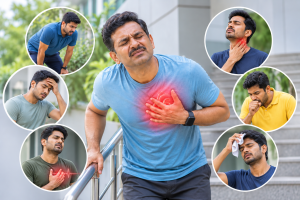
- Chest tightness or heaviness while climbing stairs
- Breathlessness after mild walking or light housework
- Unusual fatigue that rest does not fix
- Palpitations or a racing pulse during activity
- Discomfort spreading to the jaw, neck or left arm
- Giddiness, nausea or cold sweat during exercise
New or severe chest pain needs emergency care at once, especially with sweating, breathlessness or faintness. One such symptom is enough, and a routine treadmill test is the wrong route in that situation. Milder symptoms that appear only on exertion deserve a planned consultation with a heart specialist.
Common Risk Factors for Cardiovascular Disease
- Type 2 diabetes or prediabetes
- High LDL cholesterol and a skewed lipid profile
- Blood pressure that stays persistently elevated against current clinical thresholds
- Smoking, gutka, or heavy alcohol use
- Prolonged sitting through long IT shifts across Kukatpally, which raises cardiovascular risk through physical inactivity
- Premature cardiovascular disease in a first-degree relative: a father or brother before 55, a mother or sister before 65
- Central obesity, where South Asian waist thresholds are commonly 90 cm for men and 80 cm for women
- Age, which counts as one factor in an overall risk assessment rather than a reason to test
Before You Start the Gym or a Marathon
Sudden intense exercise strains an unprepared heart. However, a baseline TMT is not necessary for everyone joining a gym or training for a run. Your cardiologist weighs symptoms, cardiovascular history, risk factors and a clinical examination first. Afterwards, testing follows only where it will change the advice.
A Note for Post-Angioplasty Patients
A stent does not end your follow-up. However, a treadmill test cannot confirm whether the treated vessel has stayed open. Routine surveillance testing is not needed for every symptom-free patient. Your cardiologist therefore decides follow-up case by case.
Why Cardiac Risk Assessment Should Not Wait
Many people carry serious risk factors without noticing a single symptom. Regular cardiac screening of blood pressure, lipids, sugar and lifestyle closes that blind spot cheaply.
A resting ECG lasts ten seconds and checks a resting heart. By contrast, the treadmill test questions your heart while it works hard. The two reports answer very different questions.
Preventive Cardiology KPHB: How Our Clinic Works
Prevention guides every consultation at Gokul Heart & Cholesterol Clinic. Besides the TMT, our cardiologist maps your full risk picture before advising anything.
- Step one: a detailed history covering diet, sleep, stress and family illness
- Step two: blood pressure, waist, weight and a complete lipid profile
- Step three: a resting ECG, followed by the treadmill test when indicated
- Step four: 2D Echo or further imaging, only if the tracing demands it
- Step five: a written plan covering medication, diet and safe activity levels
We schedule your next review before you reach the billing desk.
How Often Should a Treadmill Test Be Repeated?
There is no fixed treadmill test schedule that suits everyone. A cardiologist may recommend a TMT based on symptoms, medical history, cardiovascular risk, exercise capacity and the results of previous tests. Healthy adults without symptoms do not automatically need periodic TMT screening.
National guidance advises against routine exercise ECG screening for symptom-free, low-risk adults. The evidence also remains insufficient to prove a routine benefit at intermediate or high risk. Your interval should come from your cardiologist rather than from a chart.
How to Prepare for Your Treadmill Test (TMT)
Good preparation makes the tracing cleaner and the visit shorter. It also spares you a repeat appointment.
- Follow the clinic’s instructions on eating and drinking before your slot.
- Confirm your appointment time and the expected duration while booking.
- Wear loose cotton clothing and proper walking shoes.
- Ask your cardiologist whether caffeine needs avoiding before your particular test.
- Carry every prescription, and never stop or change a medicine without instructions from the prescribing clinician.
- Reach the clinic fifteen minutes early and sit quietly.
- Tell our staff about pregnancy, any recent cardiac symptoms, asthma, or any mobility limitation that affects walking.
What to Carry
- Previous ECG, 2D Echo and TMT reports
- Your latest lipid profile and blood sugar values
- A full list of current medicines and doses
- Insurance or corporate health card, if applicable
What to Avoid Before the Test
Our team will tell you whether to avoid heavy meals, alcohol or smoking beforehand, since protocols differ. Also, avoid oily body lotion on the chest, since electrodes slip on greasy skin. Men with thick chest hair may need a small shaved patch.
What Happens During the Treadmill Test, Step by Step
Walking time and total appointment duration vary between patients. Most people walk for several minutes, while the full visit usually stays under an hour.
- Electrode placement. Our technician cleans the skin and attaches ECG electrodes to your chest, plus other sites where required.
- Baseline readings. You rest while the machine records your resting ECG and blood pressure.
- Stage one. The belt starts slowly on a gentle slope, roughly a comfortable stroll.
- Progressive stages. Every three minutes, speed and gradient increase under the Bruce protocol.
- Peak effort. Walking continues until an appropriate clinical endpoint, such as adequate exercise, symptoms or a safety-related stopping rule.
- Recovery. Walking slows down, yet monitoring continues for five to ten minutes.
- Review. Our cardiologist reads the tracing and explains the findings to you directly.
Tell the staff immediately about chest pain, dizziness or severe breathlessness. Staff will stop the belt at once and seat you safely.
Understanding Your Treadmill Test (TMT) Report
A TMT report looks technical, yet its message is simple. Basically, it answers one question: does your heart cope well under load?
Positive, Negative and Inconclusive Results
- Positive for ischaemia. Exercise-induced ECG changes may suggest reduced blood flow to the heart muscle, although they do not confirm a coronary artery blockage.
- Negative for ischaemia. No diagnostic ischaemic ECG changes are detected during an adequately performed and interpretable test. This does not completely rule out coronary artery disease.
- Inconclusive. The result cannot be interpreted confidently because of limited exercise, baseline ECG abnormalities, or other technical and clinical factors.
Numbers Your Cardiologist Reads Closely
| Parameter | What it indicates |
| Target heart rate achieved | Whether the test truly stressed your heart |
| METs or exercise capacity | Your functional fitness against age norms |
| ST-segment depression | Possible reduced blood flow to heart muscle |
| Blood pressure response | How your vessels handle rising workload |
| Recovery heart rate | Autonomic health and overall cardiac fitness |
Never self-interpret these values from an internet search. Rather, discuss them with a qualified heart specialist who knows your history.
Who Should Avoid or Postpone a Treadmill Test?
Exercise testing does not suit every patient. A cardiologist checks your condition before clearing you for the belt.
- Suspected acute coronary syndrome or an ongoing heart attack
- Unstable or uncontrolled rhythm problems
- Decompensated heart failure or severe symptomatic aortic stenosis
- Blood pressure that remains uncontrolled on the day of the test
- Acute illness, fever or any unstable medical condition
- Knee, hip or spine trouble that prevents adequate walking
Severe aortic stenosis does not rule out testing in every case. Suitability depends on symptoms, severity, the reason for testing and close specialist supervision. Patients who cannot walk enough may need a different investigation. A stress echo, a nuclear stress test and a CT coronary angiogram each supply a different kind of information. Your cardiologist chooses between them for different clinical reasons, based on your symptoms and your ability to exercise.
What a Treadmill Test Cannot Tell You
A treadmill test can sometimes show abnormal results even when significant coronary artery disease is absent. Similarly, a normal result does not completely rule out heart disease. Your cardiologist interprets the findings alongside symptoms, medical history and other investigations.
Accuracy varies with patient characteristics, baseline ECG findings, the medicines in use and test conditions. A false negative can follow a test stopped early or an effort that never reached target. No single tracing settles the question on its own.
Frequently Asked Questions About the Treadmill Test (TMT)
Is a treadmill test painful?
The treadmill test is not usually painful. You walk while a machine records your heartbeat. However, exercise may bring fatigue, breathlessness or chest discomfort, and rare complications remain possible. Our staff stop the belt the moment you ask.
How long does a TMT take?
Walking time and total duration vary between patients. Electrode placement and baseline readings take a few minutes, and most people walk for several minutes more. Afterwards, monitoring continues through recovery. Your cardiologist then explains the tracing before you leave.
What is the difference between an ECG and a TMT?
An ECG records your heart at rest for roughly ten seconds. By contrast, a Treadmill Test (TMT) records it under rising physical stress. Therefore, the TMT can reveal exercise-related changes that a normal resting ECG misses.
Can diabetics undergo a treadmill test?
People with diabetes may need cardiovascular assessment, because diabetes can dull chest pain. However, a TMT is not automatically necessary for everyone with diabetes. Your heart specialist decides after reviewing your symptoms, sugar control and overall risk.
Is a TMT safe for senior citizens?
The test stays safe under proper supervision. Our cardiologist adjusts the protocol for age, joint pain and stamina. Emergency equipment remains ready inside the room throughout the session.
Can a TMT be normal and still hide a blockage?
Yes, that possibility exists. A treadmill test cannot determine the location or the extent of any narrowing. Patients with ongoing symptoms may still need a stress echo, CT angiogram or coronary angiogram.
When do I receive my TMT report?
You receive the report on the same day at our KPHB clinic. Our cardiologist reviews the tracing with you after recovery and advises the next step straight away.
Should I stop my medicines before the test?
Never stop any tablet on your own. Certain beta blockers may need pausing, yet that decision belongs to your cardiologist. Carry your full prescription and ask our team while booking the slot.
Book Your Treadmill Test (TMT) in KPHB
Call Gokul Heart & Cholesterol Clinic on [918919607118] to check slot availability. You can also book an appointment online or walk in during clinic hours. Our team confirms whether a TMT suits you before scheduling it.
- Cardiology consultation
- Cholesterol and lipid management
- ECG and 2D Echo services

